What Is Full Grain Leather? The Complete Expert Explanation with Real Examples
The definitive, no-fluff breakdown of what full grain leather actually is, how it’s graded against the alternatives, and how to tell the real thing from a good imitation.
Full grain leather is the leather made from the top layer of an animal hide with its natural grain left completely intact, uncorrected and unsanded. It is the strongest, most durable, and highest quality leather grade because it retains the hide’s tightest fiber structure, and it is the only grade that develops a genuine patina, a gradual richening in color and texture, as it ages with use. Full grain sits above top grain, genuine leather, and bonded leather in overall quality, and it is what a leather specialist means by the term when using it without qualification.
What Is Full Grain Leather, Exactly?
Every animal hide is made of layers, and the layer closest to the animal’s outer surface is the strongest, densest, and most fiber-packed part of the whole hide. Full grain leather is cut from that exact top layer and left alone, no sanding to remove scars or stretch marks, no embossing to fake a “leather-like” texture, no correction of any kind. What you see on a full grain hide is what the animal actually had.
That single distinction, nothing removed and nothing faked, is the entire definition. Every other leather grade exists because a hide has some kind of imperfection, and a tannery chooses to sand it away, cover it up, or discard the top layer entirely and use a lower one instead. Full grain is the grade reserved for hides good enough that none of that correction is necessary.

How Full Grain Leather Is Made
Tanneries grade raw hides before any processing begins, and only a small share, generally the cleanest hides with the fewest scars, insect bites, or growth marks, get selected for full grain use. The hide is then tanned, dyed, and finished with a light protective coat, but critically, the surface itself is never sanded or buffed down. That’s the entire point: preserve the grain rather than manufacture a substitute for it.
This is also why full grain leather is comparatively limited in supply. A hide with heavy scarring, stretch marks, or branding damage simply cannot become full grain leather, no amount of tanning skill changes that, which is one of the real reasons this grade costs more than the alternatives.
Full Grain vs Top Grain vs Genuine vs Bonded Leather: What’s Actually the Difference?
This is where most confusion starts, and it’s largely because the leather industry’s naming is unintuitive. “Genuine leather” sounds like a premium claim, but it actually sits near the bottom of the grading scale, not the top. Here’s how the four common grades actually compare, side by side.
| Grade | Grain Surface | Durability | Patina Over Time | Relative Cost |
|---|---|---|---|---|
| Full Grain | Natural, unsanded, unaltered | Highest | Develops a rich patina over years | Highest |
| Top Grain | Sanded, then refinished with an embossed texture | High | Minimal to none | High to mid |
| Genuine Leather | Lower hide layer, heavily corrected and coated | Moderate | None | Mid to low |
| Bonded Leather | Leftover scraps bonded with polyurethane onto a fiber backing | Lowest | None, tends to crack and peel | Lowest |
Full grain vs genuine leather, specifically: despite the name, “genuine leather” is a mid-to-low grade made from a lower, weaker layer of the hide, sanded down and finished with an artificial texture to hide inconsistencies. Full grain, by contrast, uses the strongest layer of the hide in its natural, unaltered state. The two terms sound similar but describe leather at nearly opposite ends of the quality scale.
Worth remembering: “Genuine leather” is a grading term, not a quality claim. It ranks below full grain and top grain.
Why Does Full Grain Leather Cost More?
Three factors compound to make full grain leather the most expensive grade, and none of them are arbitrary. Supply is limited, because only a fraction of hides are clean enough to skip corrective sanding. Processing takes more skill, since there’s no sanding step to hide a tannery’s mistakes, every dyeing and finishing step has to be done well the first time. The material itself is denser and stronger, which means more raw hide is required to produce the same finished piece compared to a thinner, corrected grade.
None of that is marketing language, it’s a direct function of how the material is sourced and processed. A lower grade can be produced faster, from more of the hide, with more room for error, which is exactly why it costs less.
The grading happens before the leather ever reaches a workshop.
How to Identify Full Grain Leather
Labels aren’t always reliable, and marketing language can blur the line between grades. These five checks are what a leather specialist actually relies on when verifying a hide in person.
Look for natural, irregular grain
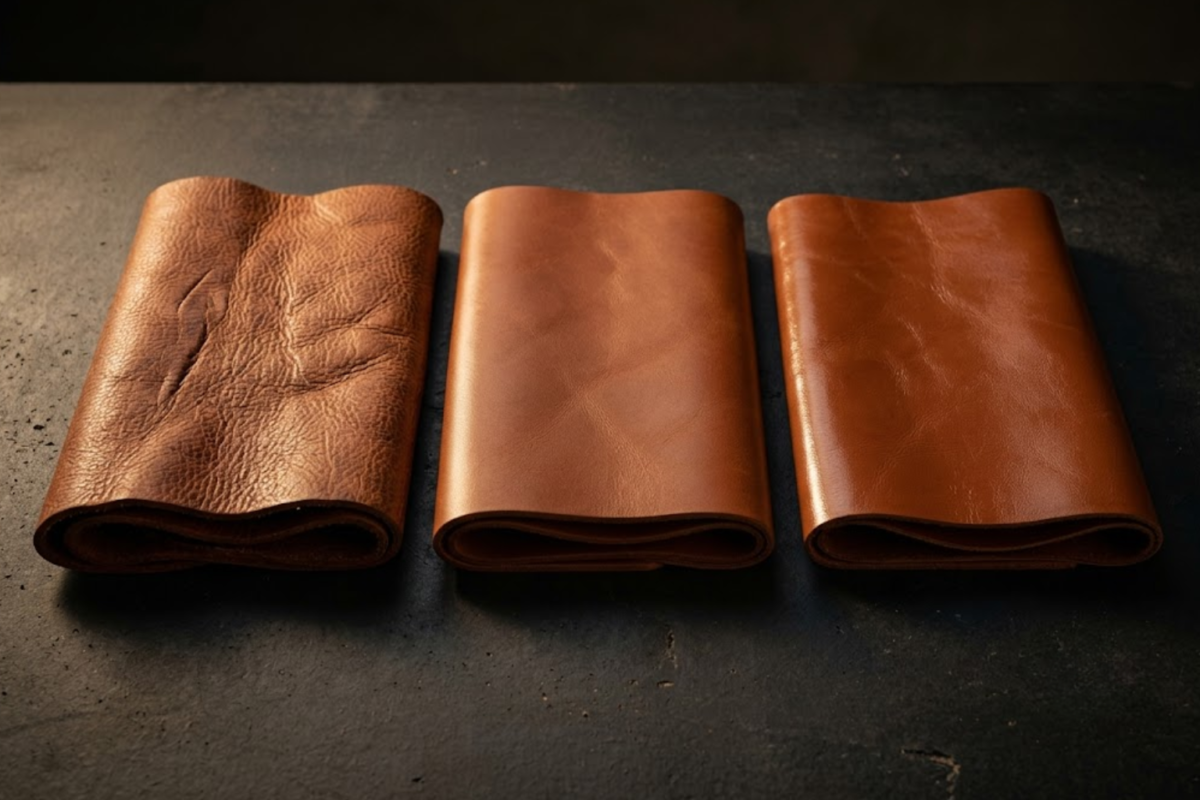
Genuine full grain leather shows subtle variation across its surface, small marks, faint wrinkles, slight color shifts. A surface that looks perfectly uniform edge to edge has usually been corrected or embossed.
Do the press test
Press a fingertip firmly into the surface. Full grain leather shows a faint, temporary indentation and slowly returns to shape. A plastic-coated or heavily corrected surface stays rigid and shows nothing.
Check the edge, not just the face
Look at a raw or unfinished edge if one is visible. Full grain leather shows a dense, fibrous cross-section. A bonded or heavily split product often reveals a layered, fibrous-paper look at the edge instead.
Smell and feel matter
Real leather has a distinct, faintly earthy scent and a warm, slightly waxy hand-feel. A strong plastic or chemical smell is a reliable sign of a bonded or heavily coated product, not full grain leather.
Ask the seller directly, and expect specifics
A seller offering true full grain leather can usually describe hide sourcing and tanning in some detail. Vague answers, or a label that avoids the phrase “full grain” entirely while implying premium quality, are worth treating with caution.

What Are the Real Benefits of Full Grain Leather?
Setting aside the grading terminology, the practical case for full grain leather comes down to a short list of genuine, measurable advantages over lower grades.
- Superior strength and tear resistance. The dense, unaltered fiber structure of the top hide layer holds up to daily stress far better than sanded or bonded alternatives.
- Develops a patina instead of wearing out. Where lower grades crack, peel, or flake with age, full grain leather deepens in color and softens in texture, improving in appearance rather than degrading.
- Naturally water and stain resistant. The tight, unsanded grain resists surface absorption far better than a corrected or split hide layer.
- Longer realistic lifespan. A well made, well maintained full grain leather item routinely lasts a decade or more, often significantly longer, compared to a few years for lower grades.
- No two pieces are identical. Because the natural grain is left intact, every full grain item carries slight, individual variation, a genuine mark of the specific hide it came from.
Common Myths About Full Grain Leather
“Genuine leather” means high quality because of the word genuine.
“Genuine leather” is a specific grading term that actually ranks below full grain and top grain.
Real full grain leather should look flawless and uniform.
Natural marks, faint wrinkles, and slight color variation are signs of authenticity, not defects.
A glossy, perfectly even sheen signals a premium hide.
Heavy, uniform sheen often indicates a corrected or embossed surface covering imperfections underneath.
Real Examples: What Full Grain Leather Looks Like in Everyday Products
The clearest way to understand full grain leather is to see how it behaves over time in something used daily. A full grain wallet carried for two years typically shows a noticeably darker, richer tone along the edges and corners where hands make the most contact, while the surface itself remains intact and supple rather than cracked. A full grain leather desk pad used for the same period shows a similar effect concentrated where wrists and forearms rest during typing, a slow, even darkening rather than peeling or flaking.
That gradual darkening is the patina referenced throughout this guide, and it’s the single most reliable real-world signal that a piece is genuine full grain leather. A bonded or heavily corrected product does not do this. It degrades instead of improving.
How Do You Care for Full Grain Leather?
Full grain leather needs relatively little maintenance, but a few habits meaningfully extend its life. Wipe it down with a dry or slightly damp cloth to remove dust and surface residue before it settles into the grain. Condition it every few months with a leather-specific conditioner to keep the fibers supple and support even patina development, and keep it out of prolonged direct sunlight, which can dry and fade the surface unevenly.
Address spills immediately with a dry cloth rather than letting liquid sit on the surface, and avoid harsh cleaning chemicals, which can strip the leather’s natural oils and finish faster than normal use ever would.
So, Is Full Grain Leather Worth It?
For anyone buying something meant to last years rather than seasons, full grain leather is the grade that actually delivers on the promise leather goods are supposed to make: durability, character that improves with use, and a material that ages rather than deteriorates. It costs more up front because less of it exists and more skill goes into finishing it correctly, not because of branding.
Lower grades have their place for lighter, less demanding use, but for anything carried, touched, or relied on daily, full grain is the grade that makes the cost difference back over the life of the product.
Compass Full Grain Leather Bifold Wallet
Built from full grain leather selected for a clean, low-mark surface, this wallet is finished without sanding or artificial embossing, so the grain shown is exactly what came off the hide. Over months of daily carry, the edges and card slots darken gradually into a deeper, richer tone, the patina described throughout this guide.
It’s a practical, everyday example of everything covered above: dense fiber structure for real durability, natural grain variation instead of a uniform stamped texture, and a material built to improve with use rather than wear out.
Frequently Asked Questions — Full Grain Leather
The most common questions buyers and researchers ask about full grain leather, answered directly.
- Full grain means unaltered, not just “real”: the defining feature is that the natural grain was never sanded, buffed, or corrected.
- “Genuine leather” is not a quality claim: despite the name, it ranks below full grain and top grain on the actual grading scale.
- Patina is the real-world proof: full grain leather darkens and softens with use rather than cracking or peeling, which is the clearest sign of the genuine grade.
Full grain leather earns its position at the top of the grading scale through a simple, verifiable fact, nothing about the hide’s natural surface has been altered. That single distinction is what drives every practical benefit covered in this guide, from durability to patina to real-world lifespan, and it’s the detail worth checking for before buying anything labeled “leather.”
At Rove Leather, every full grain product starts from that same standard, hides selected for their natural surface, finished without sanding or correction, built to develop character rather than wear out.
Shop Full Grain Leather at Rove Leather
Unsanded, natural grain · Free shipping · 14 day returns